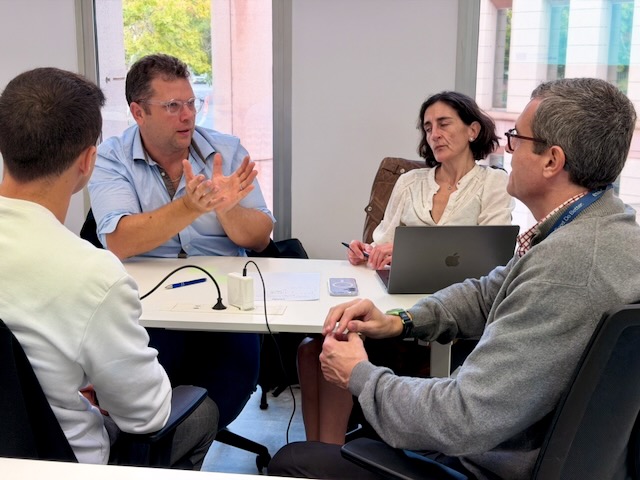
Around 23 professors, researchers, and PhD researchers spent a day at Esade Business School in Barcelona asking a question more and more educators are facing: what does teaching look like when students have generative AI in their pocket?
The workshop was organised by AI4GreenDeal, the EU-funded project developing the Master’s in Advanced Energy Systems and AI, and run by Balazs Horvath, an AI researcher and public speaker. It was practical from start to finish: four 2-hour modules, eight contact hours in total, and everyone left with something to use in their own course.
Four modules, step by step
The first module reframed the role of the educator in the age of AI: from broadcaster to learning designer, digital mentor and AI co-creator. It ended with each participant drafting an AI integration strategy for one of their own courses.
The second looked at active, AI-aware learning. Participants turned lectures into problems students have to solve, and tried “dialectical AI” activities in which students argue with the AI instead of just prompting it.
The third was about building an AI co-instructor, from tools teachers can use today to self-hosted small language models running on the university’s own infrastructure. Participants built a course assistant grounded in their own materials, and saw live how the same model behaves completely differently depending on how its instructions are written.
The fourth covered assessment, mentorship and making learning stick: process-based assessment, assignments in which students audit AI-generated work, and techniques that make AI-assisted learning last.
What participants took away
Every participant left with a personal 30-day action plan: one course, three concrete changes and one way to measure the impact.
Engy Sameer Elshair, a PhD researcher at Universitat Politècnica de Catalunya (UPC), found it useful in practice: “I found the training really valuable, especially the practical activities and the chance to explore different teaching approaches.” It made her reflect on the module she is currently teaching and gave her new ideas for making lectures more interactive.
For Mònica Aragüés Peñalba, Full Professor (ICREA Academia) in the Electrical Engineering Department at UPC, the debates and shared reflection were the heart of it: “Through debates and shared reflection, we considered how to integrate these tools meaningfully while keeping human interaction and students’ learning at the centre.”
Inge de Waard, who leads AI and Learning for InnoEnergy, points to what comes next: “The challenge is not only to use AI effectively, but to keep learning as it evolves.” She adds that the workshop worked for the whole group: “The workshop met us at our different levels of AI knowledge and moved us all forward.”
Why it matters
The Master’s in Advanced Energy Systems and AI prepares students to work where AI and energy meet. That only works if the people teaching it are comfortable with the technology their students will use, which is why time spent on teaching practice matters as much as curriculum design. It also connects to the wider skills gap we wrote about in Europe Has Named AI in Energy a Strategic Priority. Now It Needs the Engineers to Deliver It.
Learn more about the Master’s in Advanced Energy Systems and AI and about AI4GreenDeal.
AI4GreenDeal is co-funded by the European Union under the DIGITAL programme, supporting Europe’s strategic priorities in advanced digital education, innovation and the green transition.